Sunday, March 31, 2013

Visit to Sun Temple, Konark, Odisha

One of the high points of last year's Odisha/Orissa trip was visiting Sun Temple at Konark. The name Konark reminds me of Odissi performance in front from Sun Temple in one of those national integration songs in DD in early 90's. 
Kamats at Konark, Odisha
Kamats at Konark
Kamats : Since we reached Konark early in the morning, we were looking for a decent restaurant for having breakfast.  To our surprise, we found Kamats there. Whether it is the same Kamats as in Bangalore I am not sure. But what caught my attention was the menu items on offer - Indian thali, South Indian thali, Bengali thali, Marwadi thali, Gujurati thali. I could guess any regional thali(meals) but what is a Indian thali in India?
Ornamental wheel of Sun Temple, Konark
The Wheel : Konark Sun temple is a imposing structure, not to forget the intricate carvings which are hallmarks of any ancient Indian temple. What is distinguishing here is the carvings of wheels of the chariot which is driven by Sun god. You can find this as a cultural symbol everywhere you go in Odisha.

Sun Temple, Konark, Odisha
History (from the ASI board) : The magnificent structure was built in 1250 AD by the Eastern Ganga king Narasimhadeva-I(1238-64 AD) to enshrine an image of Sun(Arka), the patron deity of the place. The entire complex was designed in the form of a huge chariot drawn by seven spirited horses on twelve pairs of exquisitely carved wheels. The sanctum symbolizes the majestic stride of the Sun-god and marks the culmination of the Orissan architectural style. The vimana of the deul has collapsed while that of jagamohana and the nata-mandap are better preserved. The walls of the temple contain superb carvings of  divine, semi-divine, human and animal figures amidst floral and geometric ornamentations. Sculptures of mighty simha-gajas welcome the visitors at the porches.

One big disappointment in Konark is that you cannot get inside the majestic temple, since it is filled with sand bags by the British to prevent the collapse of the structure!

Sculptue of mighty simha-gaja, Konark, Odisha
Sculptue of mighty simha-gaja
Sculptures of Sun Temple, Konark
Sculptures at Sun Temple, Konark


Monday, March 18, 2013

Malabar Coast Photos from 2012 Year End Trip

I had been to Kerala in December 2012. Here are some of the photos from the Malabar coast or shall I say our own west coast! :)
Talangere Railway Bridge seen from Chandragiri Fort, Kasaragod
View of Chandragiri river from Chandragiri Fort
Men and boats, Bekal Fort, Kasaragod
View of Bekal Fort Beach
Talangere, Kasaragod
Fishing Waters, Talangere, Kasaragod
Talangere, Kasaragod
Can you identify the bird?

Saturday, March 16, 2013

Simple Aagond Love Story Review

Yes, it is simple and it manages to hold the attention of the audience for most part. Catchy dialogues laced with sakhath Bengaluru lingo set laugh riot. You savour  those moments when your thoughts turn into words on screen instantly.
Still from Simple Aagond Love Story
But at sometimes you feel out of synch with the outburst of words as the background commentry snatches your reaction time and it becomes even more difficult with the giggling crowd. It is a good show by the team keeping in mind that there are only few characters and they don't make you sleep. You feel boring only when the simple story takes the usual complicated twist in the climax. Though I did not fancy the climax I must appreciate director's efforts in making the audience watch the final scenes standing.

Sunday, January 27, 2013

Gudiya Sambhrama at Malleshwaram

Last weekend, during a casual conversation with Sandeep, he mentioned about Gudiya Sambhrama he was attending. Curious to find more about the event, I went ahead. So, last Saturday evening I was in Malleshwaram.
Telugu Bhagavatha Mela at Malleshwaram as part of Gudiya Sambhrama
Negotiating the heavy traffic on Sampige Road when I reached the venue(Sri Lakshmi Narasimhaswamy Temple), crowd had gathered for Prahalatha Charitram Bhagavatha Mela. Since the performance was in Telugu, I did not understand the dialogues. But I must applaud the efforts of organizers to save our heritage.
Lakshmi Narasimha Swamy Temple - Utsava Murthy
Performance and the setting reminded me of the vibrant chariot festivals back in my native, held every year. Though one cannot compare the scale of these festivals, one can feel the vibe in culture scene. Of course, the churumuri stall near the venue, spiced up the nostalgia! At this time, I also visited the famous Kadu Mallikarjuna Swamy temple nearby for the first time.
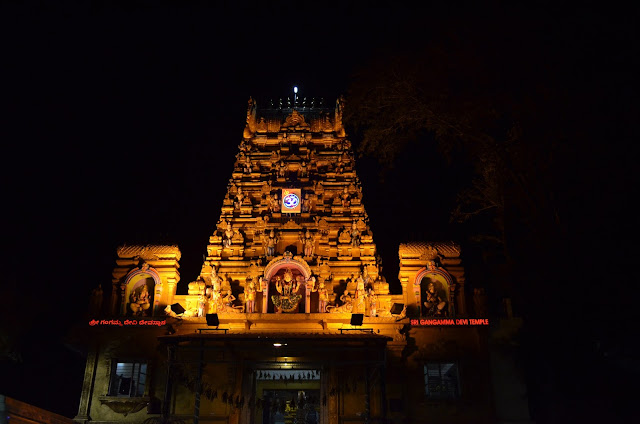
Sri Gangamma Devi Temple, Malleshwaram
I was impressed by the tagline for this year's Gudiya Sambhrama - Vruksho Rakshathi Rakshithaha(Trees protect who protect it) in the lines of Dharmo Rakshathi Rakshithaha(Dharma protects who protect it). In big cities like Bengaluru, this means a lot.
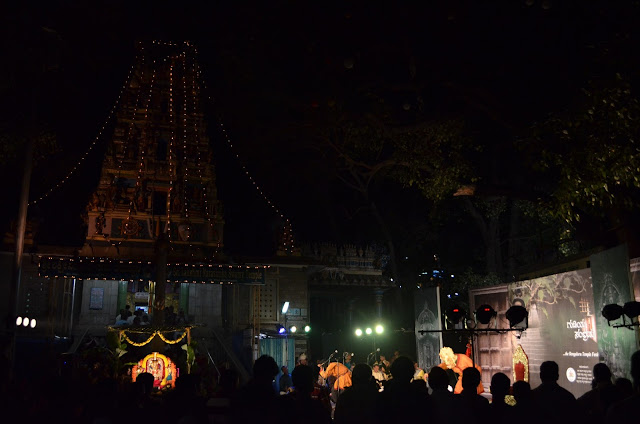
Lakshmi Narasimha Swamy Temple, Malleshwaram

Tuesday, October 02, 2012

Monday, October 01, 2012

Tokyo Travel : Meiji Shrine or Meiji Jingu

Meiji Shrine or Meiji Jingu(in Japanese) is a Shinto shrine dedicated to Emperor Meiji and his wife. As part of Tokyo city tour, we visited this place after visiting Tokyo Tower.
Barrels of sake wrapped in straw, Meiji Shrine, Shibuya, Tokyo
Barrels of Sake : When you enter the premises of Meiji shrine, you notice barrels of sake wrapped in straw stacked up near the entrance. Made from fermented rice, Sake is a Japanese alcoholic beverage. To know more about these barrels, read the following text which was written on information board put up near these barrels - "During the Meiji Era, Emperor Meiji, whose divine soul is enshrined here at Meiji Jingu, led the industrial growth and modernization of Japan by encouraging various industries and supporting technological development. Due to their grace and virtue, Emperor Meiji and his consort, Empress Shoken, the beloved mother of our nation whose soul is also enshrined here, are held in the highest esteem by the Japanese people. These sake barrels are offered every year to the enshrined deities by members of the Meiji Jingu Zenkoku Shuzo Keishinkai (Meiji Jingu Nationwide Sake Brewers Association) including the Kotokai, which has made offerings of sake for generations, as well as other sake brewers around Japan wishing to show their deep respect for the souls of Emperor Meiji and Empress Shoken. In addition to stating our humble gratitude to all of the brewers who have so graciously donated their sake, we also pray for the continuous prosperity of the sake brewing industry and all the other industries maintaining Japan's traditional culture."
Barrels of wine, Meiji Shrine, Shibuya, Tokyo
Barrels of wine : If you find barrels of sake on the right side when you enter, you will find barrels of wine on the right side. What is this about? To find read the following paragraphs from the information board - "The Meiji period was an enlightened period during which a policy of "Japanese spirit and Western Knowledge" was adopted, to learn from best of Western culture and civilization while keeping Japan's age-old spirit and revered traditions. Emperor Meiji led the way in promoting modernization by embracing many features of western culture in his personal life such as shearing his topknot and donning western attire, and in many other aspects of daily living. Among these departures, His Majesty set an example by taking western food and in particular by enjoying wine with it. The barrels of wine to be consecrated at Meiji Jingu have been offered by the celebrated wineries of Bourgogne in France on the initiative of Mr. Yasuhiko Sata, Representative, House of Burgundy in Tokyo, Honorary citizen of Bourgogne and owner of the Chateau de Chailly Hotel-Golf. Profound gratitude is due to the wine makers who have so generously contributed to this gift to be consecrated here to the spirit of world peace and amity, with the earnest prayer that France and Japan will enjoy many more fruitful years of friendship"
Water font(Temizuya) at Meiji shrine
Etiquette / Rituals : As a mark of respect following etiquette are observed at the shrine. At the shrine archway(Torii), one needs to bow once while entering and once while leaving. Before entering the shrine you need to follow the rinsing ritual near the water font(Temizuya). Using the wooden dipper, rinse your left hand and then right. Pour water into your left hand and rinse your mouth. Again, rinse your left hand and rinse the dipper. Seeing and following these rituals, I found similarities with the Dharmic religious rites in India.
Entrance to the main shrine, Meiji Jingu
Main shrine at Meiji Jingu
The Main Shrine : The main shrine at Meiji Jingu does not have any images or idols typical of Shinto religion. Here, one can drop coins in the offertory box kept. To offer your prayers at the main shrine, one needs to follow the following etiquette - at first, bow twice and clap with your hands twice. Then, make a wish and bow once again.
Camphor tree and wish tablet, Meiji Shrine, Tokyo
Offerings and Wish Tablet :  Near the main shrine is the camphor tree around which wish tablets are hanged. Visitors can write their wishes on the wooden tablet (called Ema) and hang it on the hooks provided around the tree. One can write their wish in any language.
A Shinto wedding procession at Meiji Shrine, Tokyo
Marriage Ceremony : When we visited the Meiji shrine, we witnessed a Shinto wedding procession which  was led by two priests and two shrine maidens, followed by the couple under a red umbrella and the family and friends. It was delightful seeing the colorful ceremony in wonderful surroundings.
Condolence messages from major countries after the demise of Emperor Meiji, Meiji Shrine, Tokyo
Forest at Meiji Shrine : It is amazing seeing the premises of Meiji Shrine full of greenery. More so, because you find the forest right in the middle of a highly modern and most populous city in the world. The trees here are planted by hand about 90 years ago consists of many endangered plants and animals. This further thrusts the importance of human will and effort in recreating the lost Edens eleswhere in the world!

LinkWithin

Related Posts with Thumbnails