Sunday, July 17, 2011

Mahabalipuram Trip - Part 3 : Arjuna's Penance, Krishna's Butter Ball, Varaha Cave Temple and Tiger's Cave

Arjuna's Penance : The huge relief structure, Arjuna's penance is also called the Descent of the Ganga. Story from Mahabharata, where Arjuna performs tapasya(penance) to get Pashupatastra from Lord Shiva is depicted here. In addition, the story of Bhagiratha's efforts to bring divine river Ganga to earth finds place here. Arjuna's penance, Mahabalipuram
Arjuna's penance, Mahabalipuram
Arjuna's penance is a structure measuring 30m (100ft) long by 15m (45ft) high, quite huge compared to human figure. Near to the Arjuna's penance, you can find the Krishna Mandapa. Walls of the Mandapa tell the story - how Lord Krishna lifted Mount Govardhana to protect the villagers when the rain god Varuna vented his anger by bringing incessant rains.Lord Ganesha Temple, Mahabalipuram
Lord Ganesha Temple, Mahabalipuram
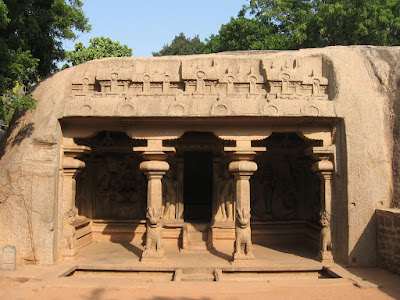
Varaha Cave Temple and Krishna's Butter Ball : Moving on we spotted Varaha cave temple next. On way to cave temple, one finds Lord Ganesha temple, where unlike many temples in historic places, poojas seem to be conducted. But surprisingly, there was no statue of the god in the Varaha cave shrine. But one could find carvings of Varaha on temple wall. On the rocky hill nearby, Krishna's butter ball is a huge mounted rock, with virtually no support. People posing for photos as if they are holding it from rolling down was a common sight. Well, we did take our turn in doing so too! Down the hill, we found one more cave temple but dedicated to Lord shiva.Varaha Cave Temple, Mahabalipuram
Varaha Cave Temple, Mahabalipuram
Tiger's cave : That brought an end to the visual treat we could have at Mahabalipuram town. But I had read in a travel guide about the Tiger's cave which is located 5 km before entering the Mahabalipuram town. So, I made sure to ask the driver to stop there. Apart from the cave, it is surrounded by trees, making it an ideal place for picnic.Krishna's Butter Ball, Mahabalipuram
Krishna's Butter Ball, Mahabalipuram
Chennai Bits : Don't know is it because of the part of Chennai we explored, I noticed only few big commercial complexes or modern glass buildings, a far cry from a city like Bangalore. Of the few, Hilton Chennai caught my attention for a while! Chennai traffic which greeted us on that day morning did say bye in the evening too, again in the same fashion - traffic jam. We had to get down from the Volvo bus we boarded to reach CMBT and walk to catch the KSRTC Corona to reach Bengaluru next day morning.Hilton Chennai
Hilton Chennai
Afterthoughts : After completing a series of posts on Mahabalipuram, I felt that any documentation on India's heritage site always leaves genuine readers wanting for more, purely because of the intricacies of architecture and not to forget the history and mythology associated with the place and the work of art. Here, I have tried to highlight only few aspects. If it arouses interest in the minds of readers about the rich heritage of India, I would consider my efforts fruitful. For more details on Mahabalipuram, click here. Also, another thought passes by - if Mahabalipuram trip travelogue has to be stretched into 3 parts and required as much effort, what it would take to document the vibrant Hampe(Hampi)? :)Carvings on wall of Varaha Cave Temple, Mahabalipuram
Carvings on wall of Varaha Cave Temple, Mahabalipuram
Cave Temple dedicated to Lord Shiva, Mahabalipuram
Tiger's Cave, Mahabalipuram
Sunset at Chennai
Sunset at Chennai

Thursday, July 07, 2011

Oriyardori Asal - Film Review

Movies can be entertaining or thought provoking. Tulu movie Oriyardori Asal, falls into both the categories. So, it is clear that why it has drawn crowds in Mangalore and Udupi districts. Oriyardori Asal literally means one better than the other. The film is based on the Tulu drama of the 90's of the same name. Punch dialogues of the drama are part of modern Tulu folklore! Evidently, the film has been able to take full advantage of that.

Objective Note : Film begins with talks of highs and lows of Tuluvas, takes note of the people who have excelled for the right reasons and mentions few who have become infamous for wrong reasons. Also, it discusses the present challenges faced by Tulu Nadu, Tulu language not being included in the 8th schedule of constitution. Director of the movie, Vijaya Kumar Kodialbail has dared to present several issues upfront, which is a positive note for the marginalized linguistic community as well as for the coastal region. In his effort, he also makes a passing mention of the communal tensions marring the region in recent years.Naveen D Padil, Aravind Bolar in Oriyardori AsalWhat to look out for : Needless to say dialogues are the most entertaining part of the movie. With the likes of Naveen D Padil and Aravind Bolar you are destined for full throttle of laughter all the time. Some of the dialogues and characters have been modified to suit the new age - like driver Babanna's never ending lines - Yaan panpun daada panda... (translated : What I want to say is..) during Bhoota Kola have been totally removed and replaced with his cell phone histrionics or say the character of coconut plucker Naathu who comes well dressed with a brief case to hold the coconut plucking tool! Film is also not devoid of glamour too as it has Ramya Barna of Pancharangi fame as heroine. Famous song from the original drama Bhageerathammana Per, Aitundu Ardhala Neer finds new tune here. There is also a song shot entirely in Mumbai, with lyrics in Tulu and Hindi with a Marathi line too - Sundar Sundar Amchi Mumbai shows Tulu dramatist's longing for Mumbai. Technically, I have no doubt in my mind to say that this Tulu movie is on par with the films made in Gandhinagar.

'Star' Cast : Kannada music director Gurukiran who hails from Mangalore makes a guest appearance in a song. Mr.World Raymod D'souza has a brief role in the film too.Likhit Shetty and Ramya Barna in Oriyardori AsalThought provoking questions : An inept government body governing the city, leaders who are not ready to protect the fertile lands from polluting industries, deteriorating values among people - all come under hammer. High literacy rate and the presence of Tuluva people in prominent positions - have not ensured the constitutional recognition for the lingua franca of this coastal region. Though the film puts across these questions to the audience, treatment is superficial.

Asserting identity : Vijaya Kumar Kodialbail already said that he will announce the name of his next movie on the 100th day of the movie Oriyardori Asal. Nice to see such development for Tulu cinema which has only about 40 films to its credit. Apart from that, two other minority languages of Karnataka - Kodava and Beary are also finding their voice through cinema. Kodava movie - Jadi Male got released last year. Kannada actor Shiwadhwaj Shetty is directing the Kodava movie - Naa Puttna Mann. Beary language got its first film ever this year.

Going places : Encouraged by the stupendous success of the movie, Vijaya Kumar Kodialbail intends to release the movie in neighboring Kasaragod, of course Mumbai and Gulf countries, where Tuluvas have a good presence. Not to worry, film is going to be released in Bangalore too. As per the latest information, Oriyardori Asal will be released in Bangalore on Friday, 22nd July, 2011 at Gopalan Cinemas, Mysore Road (7 PM show).

Update - 25/07/2011 : As per the latest info available in media, due to technical reasons, Oriyardori Asal was not released in Bangalore on 22nd July 2011. Instead it will be released this Friday, July 29, 2011.

Update - 18/01/2012 : New Tulu film - Aamet Asal Eemet Kusal starring Naveen D Padil, Sai Krishna and directed by Ranjan Raghu Shetty will be released in the month of February 2012.

Happy viewing!

Monday, June 27, 2011

Mahabalipuram Trip - Part 2 : Pancharathas and Hill Temple

Back from Shore Temple, we went to Pancharathas(literally meaning five chariots). These monolithic structures which date back to 7th century, are named after the five Pandavas and Draupadi. Knowing a bit history of the place whenever you visit a tourist place can add to the excitement and thrill of the trip! Well, I have experienced it when I visited Chitradurga fort. I had read the Kannada novel, Hamsageethe. Though it is a work of fiction, historical elements are nicely blended, which makes you feel it is a real story. Now, lets turn back the pages of history about Pancharathas.Pancharathas, Mahabalipuram
Pancharathas, Mahabalipuram
Bit of history about the Pancharathas : This is what ASI(Archaeological Survey of India) plaque at the place had to say about the Pancharathas - "These monolithic temples are known as Rathas as they resemble wooden chariot and they are an innovation of Pallava king Narasimhavarman I (Mamalla)(630-668 AD). A huge rock sloping from south to north was utilized judiciously to cutout different forms of temples, besides few animal sculptures. Though these monolithic temples are termed as Panchapandava rathas, they have nothing to do with Mahabharata. These rathas with their ekatala to tritala vimanas and different in plan and elevation exhibit splendid forms of south Indian art and architecture.Draupadi Ratha
Draupadi Ratha, Mahabalipuram
The Nakula-Sahadeva ratha has apsidal vimana. A relief sculpture of Ardhanariswara on the wall of Dharamaraja ratha with perfect balancing of the masculine and feminine features is considered to be one of the finest specimen of early Pallava plastic art. The ratha also contains pallava grantha inscription recording the titles of Narasimhavarman I. The group of five rathas were executed as models of south Indian temples and were not consecrated as their stupas are still attached with the bedrock."Bhima Ratha, Mahabalipuram
Bhima Ratha, Mahabalipuram
The first structure you find here is named after Draupadi, is different from other rathas as there are less carvings and the dome resembles the roof of a hut. Also, this is the smallest ratha. Next you can find the Arjuna Ratha. Further Bhima Ratha covers a large area, seemingly attributed to the large built of Bhima. Dharmaraja Ratha, is a larger version of Arjuna Ratha. You will find Nakula-Sahadeva Ratha on your right. For more info on the Rathas, you can visit this link. Apart from these structures you will also find statues of Nandi(bull), lion and elephant.Nakula Sahadeva Ratha, Mahabalipuram
Nakula Sahadeva Ratha, Mahabalipuram
From Pancharathas, on way to Arjuna's Penance, you will find the hill temple. You can walk up the hill, to get a nice view of the Mahabalipuram town and sea nearby. I felt the hill temple similar to the Stone chariot at Hampi though the wheels are not present here.
Dharmaraja Ratha, Mahabalipuram

Nandi Statue, Mahabalipuram

Hill Temple, Mahabalipuram

Sunday, May 29, 2011

Mahabalipuram Trip - Part 1: Shore Temple

First Impression: It was my first visit to Chennai and the first sight when we(me, Manju and Harish) reached Chennai Mofussil Bus Terminus or CMBT at Koyambedu on a Monday morning was not a pleasant one. Several bays in the bus stand full of plastic and garbage made it an eyesore. Coming out from there, we were greeted by several auto drivers making a beeline for potential passengers, a familiar scene in any Indian city. Well aware of the fact that Chennai auto drivers do not use meters for charging customers, we went to the prepaid counter to get an auto to Virugambakkam. Though the guy at the counter issued a receipt which was half the price others were quoting right at the gate, we soon realized that was more than double the price we would have paid in Bangalore for the same distance(around 3-4 km's)Shore Temple, Mahabalipuram
Shore Temple amidst greenary
Oh no, Traffic Jam here too! : Jammed traffic was an inconvenience which did delay the process of reaching our venue. When asked about the jams, auto driver maintained that it was only on Mondays. But roads dug up for Chennai metro work indicated it was not a weekly affair. Having a Tamil speaking guy(Harish) in our group made things simpler when we had to inquire with the hotel receptionist in Tamil about the booked rooms. We had come for a friend's wedding which was scheduled in the evening. So, we had a whole day free to explore in and around the city. With my interest in historical places, I already had Mahabalipuram in mind. After checking into our room, we got a call from our bridegroom-friend. First thing he asked was whether the AC is working properly. We thought it was the right question to ask in a city like Chennai, where temperatures can rise up to 42 degree Celsius. On the other hand, Harish's friends in Chennai advised against going to Mahabalipuram because of two reasons, chief being the hot weather and the time it will take to reach there tackling Chennai traffic. But we had already made up our mind. Soon, we called up a taxi guy for a day's rental.Close up of Shore Temple, Mahabalipuram
Close up of Shore Temple, Mahabalipuram
ECR : When we started from Virumbakkam, it was around 11 30 am. Though we had to counter the Chennai traffic again, once we reached East Coast Road(ECR), it was a smooth drive. ECR running along the sea coast is dotted with resorts. Thought it would be good option to try next time. 60 km distance was not a long one and after one and half hours, at around 1 pm, we were at the outskirts of Mahabalipuram getting down for lunch. Ready to experiment with the East coast sea food cuisine, I ordered a fish curry only to find it not good:( Oh! Forgot the name of the fish too!Front view of Shore Temple, Mahabalipuram
Front view of Shore Temple, Mahabalipuram
Shore Temple : Entering Mahabalipuram, first we stopped at the Shore temple, picture of which you will find in travel brouchers or in google image results! This is the first historical temple, I have seen at the sea shore. Amazing sight it is - with sea waves on one side and an architectural wonder on the other. Green pasture around the temple is well maintained by Archaeological Survey of India(ASI) and gives the temple the unique look. Unlike the temples in the main land, temples at the sea shore suffer from erosion. It was evident from the lack of fine carvings, if you see the temple today. But it should be noted this has been in existence for more than 1300 years now. The temple dates back to 700-728 AD during the reign of Pallavas. Though it seems like there are 2 shrines looking at the 2 gopuras, there are in fact 3 shrines. Main sanctum sanctorum of Shore Temple, Mahabalipuram
Main sanctum sanctorum of Shore Temple, Mahabalipuram
2 of the bigger shrines with gopurams are dedicated to God Shiva and the smaller shrine in between is dedicated to God Vishnu, thus honoring the beliefs of both Shaiva and Vaishnava sects. This is very rare as you will find either temples dedicated to either God Shiva or Vishnu in other historical places in India. Main sanctum sanctorum (garbha gudi) houses big Shivalinga. But as I clicked flash on my camera there, I could hear some creaky sounds from inside the temple. When we went to see what is it, battalion of bats was hanging from the roof. It seemed ironical that even after being one of the World heritage sites in India, place was in such a pathetic condition. Then we went to the Vishnu shrine where a reclining Vishnu idol is carved. Yet to find the significance of the carving of reclining Vishnu.Reclined Vishnu Idol, Mahabalipuram
Reclined Vishnu Idol, Mahabalipuram
Camera Fiasco : Soon after that we had the inevitable photo sessions at the historical place, some for Facebook and some for the memories!! When we had to take a group photo, we handed over the digital camera to a guy who sincerely told us he does not how to take a picture using it. As usual, we insisted to hold the click button for a few seconds. To our surprise, he held the camera in opposite direction about to take a picture of himself without knowing where the click button was. Now, we were sure that we gave the equipment to the wrong guy. It also made us feel we should not take things granted like this - assuming everyone in the world knows how to operate a digital camera! Fortunately we found another person who knew how to use it.
CarvingsBang on Target : After the shore temple visit, our immediate destination was the beach nearby. On the way, we could spot a Thiruvalluvar statue. Nearby that we saw few people standing around the balloon shooting place. We took a plunge. Harish was the first to pick the gun for the shots and he had all six bullets on target - six balloons busted. When our turn came, me and Manju drew blank - none of the bullets made an impact! Walking on the sand, we went on to touch waves of Bay of Bengal. Till today, I have seen only Arabian sea. So, to have a glimpse of Bay of Bengal in Mahabalipuram was special. Though the sea, the waves were the same here too :), sun over the top was hotter than West coast of India. Without spending much time, we headed back to our next destinations - Pancha Rathas. While returning from the sea shore, inspired by Harish's performance, I picked the gun again - this time the score was better - 3 out of 6 shots were on target!Thiruvalluvar Statue, Mahabalipuram
Thiruvalluvar Statue, Mahabalipuram

Bay of Bengal, Mahabalipuram

Idols on display, Mahabalipuram

To be continued...

Wednesday, January 05, 2011

Kanasembo Kudureyaneri Film Review

Girish Kasaravalli's latest venture Kanasembo Kudureyaneri looks at how differently men view death. Changes have been made to the original story by Amaresh Nugadoni on which the film is based and it presents the rational side of things as is the case with most of Kasaravalli's films.

At the beginning of the film, audience is presented with a quote of Jean-Luc Godard, a famous French film maker - “A story should have a beginning, a middle, and an end... but not necessarily in that order” and spectator realizes this as the movie progresses. The film presented as a sequence of events happening during three days are not in chronological order. This presentation may create confusion in the minds of those who have already read the story and also those who have not read it. This may also prompt them to go for a second viewing too.
Vaijanatha Biradar in Kanasembo Kudureyaneri
Picture Courtesy : nowrunning.com
But to get the gist of the story, this is not a hindrance. This technique of randomly presenting the scenes is not new to Kannada industry, as director Upendra presented the same in his debug film as hero in 'A'. He called the technique '2-D' then and asked for a intelligent audience for his film. One different aspect of Girish's films is his use of different dialects of Kannada. If it was Kundapura Kannada in Gulabi talkies, it is North Karnataka lingo here.

Man's dreams are a product of his beliefs. There are no dreams without beliefs, and there is no life without dreams. Modern civilization has impacted human thinking in a profound way. His beliefs have changed. Hollowness of human relations gets exposed very easily during these times. As he becomes more logical in his thinking with selfish motives he tries to keep away from his loved ones(or once?). The film explores all these aspects in a sensitive manner. Film has been presented with light hearted humour as well as sarcasm. Vaijanath Biradar who is branded as a comedian gives one of his best performances here as a grave digger. So, is Umashri who acts as his wife.

As far as the title is concerned(Kanasembo Kudureyaneri - Riding the stallion of a dream), it is appropriate as the film is the sum total of Eerya(Biradar) and his wife's dreams. It is difficult to present dream on screen. Kasaravalli succeeds partially in that. Film as such is a worth watch.

Saturday, October 02, 2010

Learn Tulu Series in Kannada now!

I am overjoyed by the responses to my Learn Tulu series of posts. These posts have received the highest number of page views as well as comments from my readers. Thank you all for the same. After seeing the interest among the readers to learn the language, I am confident that Tulu language will definitely survive many more years contrary to what UNESCO's report has indicated. I had started Learn Tulu series last year primarily to spread the language and save it from extinction.

By the way, some of the readers have expressed their concern about the pronunciation and suggested to write these posts in Kannada script too. Though I have used the transliteration convention used by Baraha software, there may be cases when the reader can get confused. So, in my Kannada blog, I have started the same series using Kannada script, which can serve as a proper pronunciation guide as with Indic scripts, what you write is what you read. So in future, you get to see the new articles on Learn Tulu Series in both English and Kannada blogs. You can read the previous articles of the series in my Kannada blog here.

LinkWithin

Related Posts with Thumbnails